A unified approach that connects every touchpoint from first click to loyal customer, closing the gaps where leads and revenue are lost.
Many businesses run marketing campaigns continuously — social media posts going out every week, Google Ads spending every day, email newsletters going out every month — and still struggle to see consistent, predictable revenue growth. The problem is rarely the channels themselves. The problem is that the channels aren't connected.
Your paid ads drive traffic to a landing page that wasn't built to convert. Your email list gets newsletters but no structured nurture sequence. Your CRM has leads in it that nobody has followed up with properly. Each piece is doing its job in isolation. But nobody is accountable for what happens between them — the gaps where leads are lost and revenue is left on the table.
Growth marketing is the discipline that closes those gaps. It's a full-funnel approach — one team, one strategy, one data model — covering every stage of your customer journey from first contact to repeat purchase and referral.
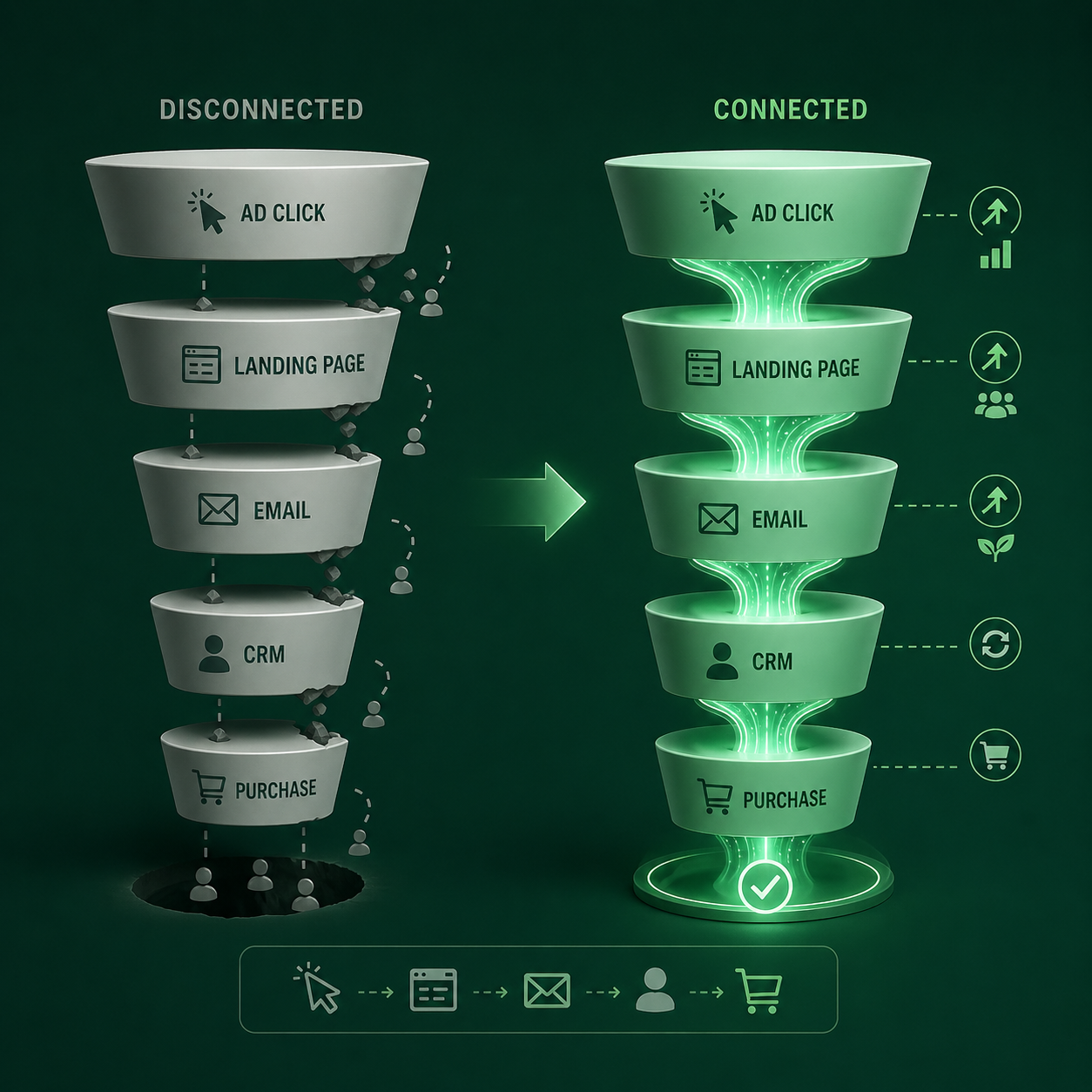
We begin by mapping your complete customer journey — every touchpoint from the first awareness trigger to the final conversion and beyond into retention and referral. Most businesses have never done this rigorously. When you see it laid out clearly, the gaps become obvious.
We then build a strategy to address every stage, with specific channels, content, and conversion mechanisms assigned to each. This is the document that governs everything else. Without it, you're running tactics without a strategy — and wondering why growth isn't compounding.
Growth marketing means managing multiple channels simultaneously with consistent messaging, shared data, and coordinated timing. We orchestrate campaigns across paid social, paid search, organic search, email, and retargeting — ensuring that every touchpoint builds on the previous one.
A prospect who sees your Meta ad, then finds your blog through Google, then receives a targeted email sequence, then sees a retargeting ad with a case study — that prospect converts at a significantly higher rate. Multi-channel orchestration makes this happen systematically.
Getting traffic to your website is half the job. Converting that traffic into leads or customers is the other half — and it's where most businesses leave the most money on the table. We run structured CRO tests covering:
Growth marketing is fundamentally an experimental discipline. We run structured experiments across channels, creative, messaging, and conversion elements — each with a clear hypothesis, a defined success metric, a minimum sample size, and a timeline.
Winning experiments are scaled. Losing experiments generate learnings that inform the next test. This structured experimentation is what separates businesses that grow predictably from those that grow in bursts followed by plateaus.
The majority of leads are not ready to buy the first time they encounter your business. Effective lead nurturing dramatically increases the percentage of leads that eventually convert. We design and build automated email sequences that nurture prospects from initial interest through to purchase.
Growth marketing requires a single source of truth for performance data. We build a unified analytics and attribution framework covering:
Growth marketing is not the right service for every business at every stage. Here's how to know if it's right for yours.
You're getting visitors, you're getting enquiries, but the conversion rate is inconsistent and you don't know why. Growth marketing will systematically find the friction points in your funnel and remove them.
You're past the early stage, revenue is growing, and you need a proper growth engine — not just one or two channels managed separately. You want one team that sees and optimises the full picture.
You have paid ads, email, content, and social all running — but they don't feel connected. Nobody is accountable for the journey between channels. Growth marketing closes that gap.
You've worked with an SEO agency, a paid ads agency, and a social media agency. Each reported on their own metrics. But the overall business impact was unclear. With Kisslead, one team is accountable for the full system.